… on gaps#
Gaps in Historiography#
In ancient historiography, depictions of one and the same event vary depending on the author and the work. A decisive characteristic of any depiction is the selection an author has to make.
Certain information, causal connections, and motives are included in the text, while others are not. The aim in Roman historiography is a coherent representation of history, which, from today’s perspective, is nevertheless biased.
If we compare several versions of an event in different ancient texts, we can also identify which specific pieces of information authors chose not to include. This absence often has strategic or literary motives.
Digital methods are now intended to support the systematic study of such gaps.
Research question:
How can the absence of a piece of information in a work of ancient historiography be identified and interpreted?
In a research tandem with the NLP expert Konstantin Schulz from the Daidalos team, a professor of Classical Philology investigates this question from a literary studies perspective.
To explore this question using the example of the Conference of Luca (56 BCE), an innovative combination of Natural Language Processing (NLP) methods is employed.
First, Named Entity Recognition (NER) is used to systematically identify passages that mention the Conference of Luca, and those that should mention it but do not. The texts are then examined using sentiment analysis to investigate the emotions, moods, and attitudes they convey, in order to determine how omissions relate to the narrative.
Information about the text corpus:#
Languages: Ancient Greek; Latin
Period: 1st c. BCE – 3rd c. CE
Genres: Historiography, biography, letters
Authors: Cassius Dio, Cicero, Plutarch, Velleius Paterculus, Suetonius, Appian
Keywords: Roman historiography, historiography, epistolography, (First) Triumvirate, Conference of Luca, narratological gaps, omissions, Caesar, Pompey, Crassus
Structure of the text corpus:#
Study corpus: Texts without mention of the Conference of Luca:
Cassius Dio, Roman History 39.24–36
Reference corpus: Texts that do mention the Conference of Luca (“reference narratives”):
Cic. fam. 1.9.8–9
Suet. Iul. 24.1
Plut. Caes. 21
Plut. Pomp. 51
Plut. Crass. 14–15
Plut. Cat. min. 41.1–2
App. civ. 2.17
Vell. 2.46.1–2
Expanded corpus:
Cass. Dio 37; 41
App. civ. 2
Caes. civ. 2
Methodology, workflow, and challenges:#
Preliminary considerations:
The working hypothesis for this study is that certain historiographical gaps are not the result of missing sources, but instead serve a literary function. At the beginning of the collaboration, therefore, the question arises of how such gaps can be identified methodologically in historiographical texts at all.
A concrete case study is needed: Cassius Dio, writing his Roman History in the 3rd century CE, does not mention the Conference of Luca. Since other authors such as Cicero and Suetonius (see above, reference narratives), to which Dio certainly had access, address it in various ways, the Conference of Luca is a suitable object of study for this research tandem.
For comparison, the team examines authors who explicitly refer to the Conference of Luca: Caesar, Pompey, and Crassus meet to agree on a unified political strategy.
To continue working with the concept of a “gap,” a precise description is required of what this means in the literary-critical sense.
What is a “gap”?
We use the term “gap” to refer to the absence of an explicit mention of the Conference of Luca in Cassius Dio. What is meant is the conspicuous omission of information in a text. The conspicuousness arises through comparison with parallel texts that describe the same (historical) event—that is, the same time and the same occurrences. The reference narratives draw attention to the omission in another text.
When does a “gap” become meaningful?
A “gap” becomes meaningful when the text itself provides evidence that the omission contributes to the narrative’s literary effect, for instance because it is necessitated by the unfolding plot.
Methods:
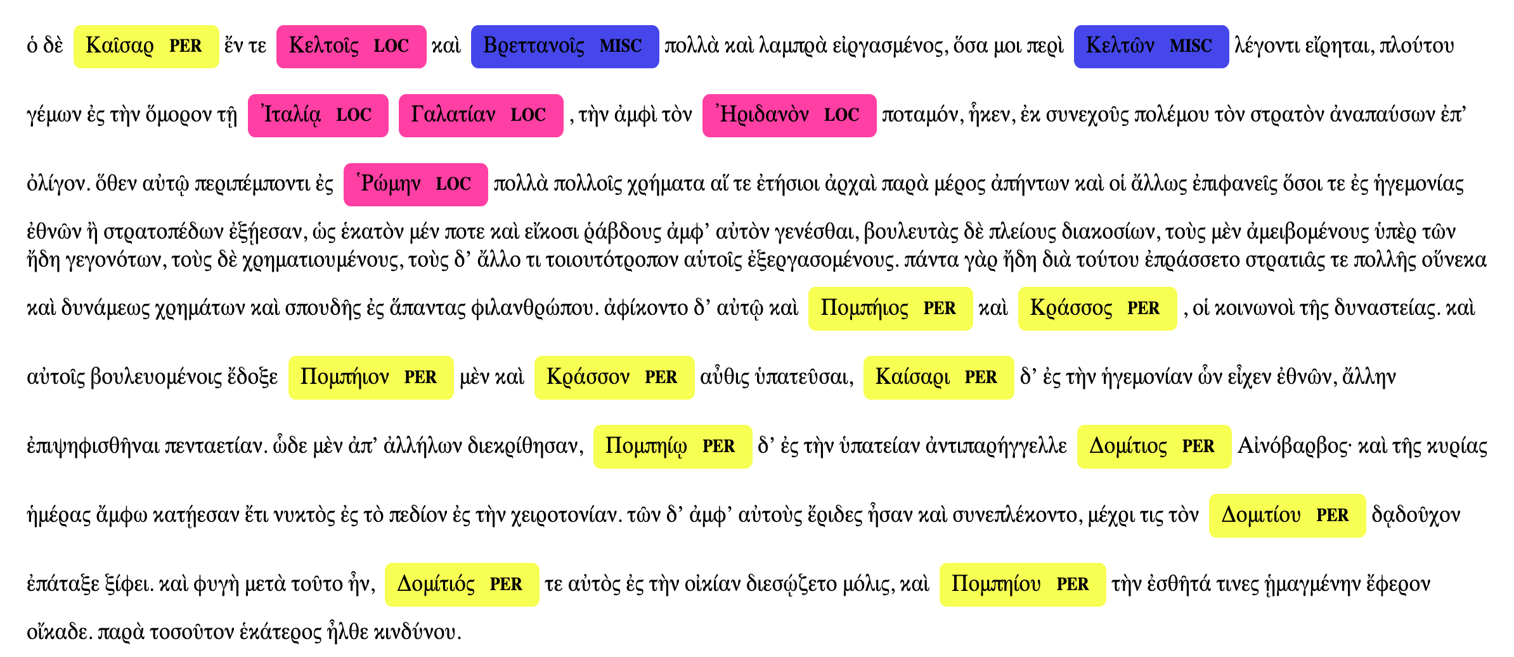
Figure 1: Visualization of named entities in the text using the Daidalos tool on an example from Appian.
To capture how authors who explicitly mention the Conference of Luca describe it, the first step is to apply NER.
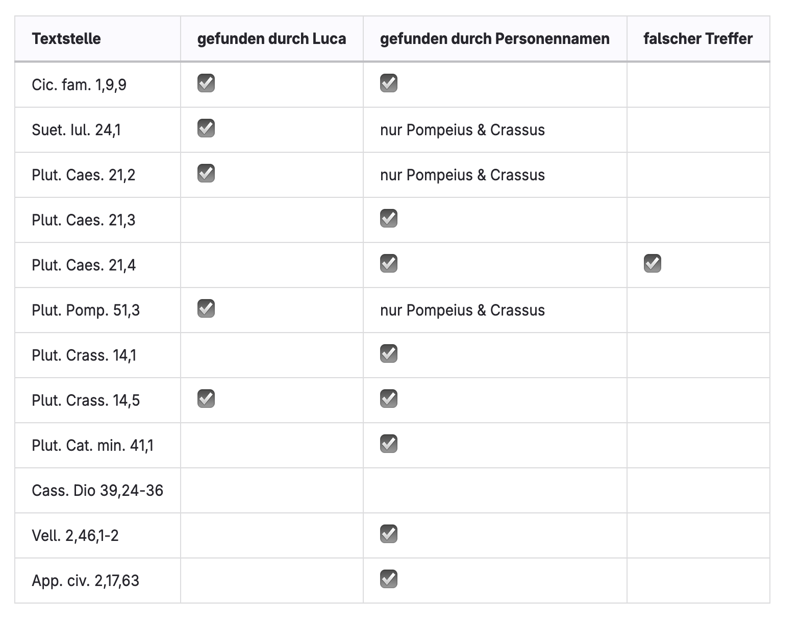
Figure 2: List of hits showing ‘found via Luca’, ‘found via personal names’, ‘false hit’; descriptions of the Conference of Luca are identified reliably, except for one false positive.
In the next step, a sentiment analysis is used to help answer the following questions:
Does Cassius Dio’s text reflect the early negative relationship between Pompey and Caesar that underlies the “gap” concerning Luca?
Can the “gap” be linked to the emotional tone or mood conveyed in the passages that frame it?
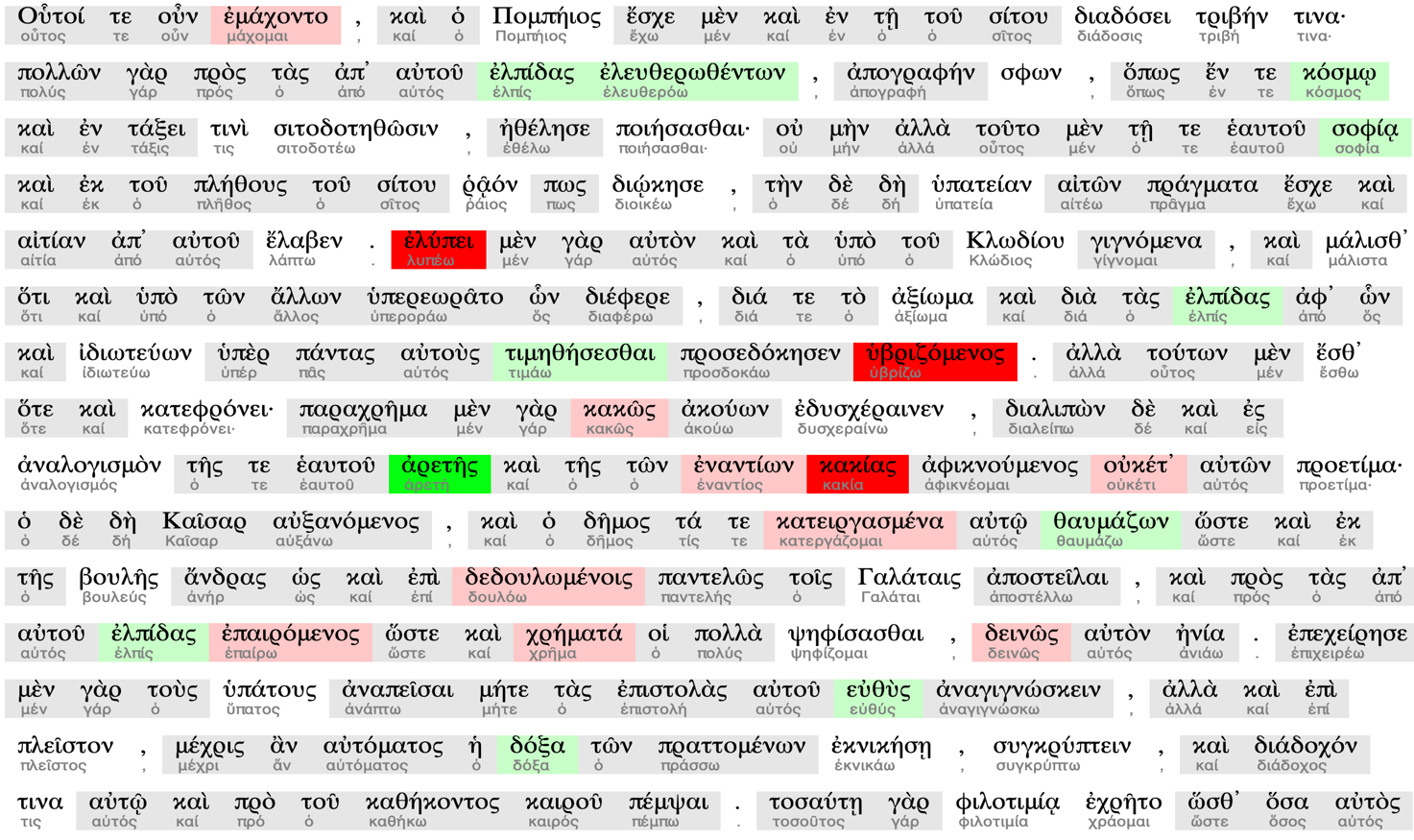
Figure 3: Cassius Dio, opening; color-coded sentiment representation.
Meaning of colors for sentiment values:
Color |
Score |
Meaning |
|---|---|---|
green |
+1 |
positive |
light green |
+0.5 |
rather positive |
grey |
0 |
neutral |
light red |
-0.5 |
rather negative |
red |
-1 |
negative |
white |
— |
word not in the sentiment lexicon / no label |
Challenges:
For Latin, the sentiment lexicon LatinAffectus is used. Currently, however, no scientifically validated sentiment lexicon exists for Ancient Greek. To prevent the tandem from getting stuck at this point, the experimental use of a large language model offers a potential way forward.
Additional step: Creating a new Greek sentiment lexicon using AI#
A detailed description of the steps taken to create this Greek sentiment lexicon based on LatinAffectus can be found here.
In brief:
From the PROIEL Treebank, Konstantin extracts a list of 9,400 Greek lemmas. He then writes a prompt for a large language model (an instruction in natural language specifying the context and the task). The output is intended to mirror the structure of the Latin sentiment lexicon so that the sentiment values are comparable.
Thanks to this abbreviated workflow, the lemmas and their corresponding sentiment values were generated in a short time. The only inconvenience was dividing the 9,400 lemmas into batches of 1,000 to stay within the model’s “attention span”. This limitation is deliberately built into the system for technical reasons.
Next iteration: Adjusting the sentiment lexicon#
When reviewing the results, the professor identifies shortcomings in philological accuracy. Contextual factors such as negation are still ignored, which creates challenges for interpretation.
More generally, further adjustments are necessary: the Latin sentiment lexicon contains only nouns and adjectives and—at approximately 6,000 items—fewer lemmas overall than the newly created Greek lexicon.
As it turns out, Cassius Dio uses more verbs than the other authors, which reduces the meaningfulness of the initial results. This is evident in the number of unclassified words: for 87% no sentiment value can be determined.
To increase consistency, all verbs are removed from the Greek sentiment lexicon. This aligns the number of lemmas more closely and makes the sentiment analyses of Greek and Latin texts more comparable.
Even at this stage, not all challenges are resolved: In the first round of analysis, Cassius Dio’s sentiment values had been significantly more negative than those of the other authors. After the adjustments, however, he ends up only in the middle range. For now, the findings move away from the initial hypothesis that Dio’s narrative is markedly more negative from the outset.
Next steps: Combine methods and continue research#
To improve the study, the tandem will need to consider various influencing factors, such as:
Author: How negative is Cassius Dio’s writing in general?
Language: Is Ancient Greek generally more positive than Latin?
Genre: Is historiography generally more negative than biography, etc.?
These questions must be addressed to answer the initial hypothesis.
For the professor, one thing is clear:
working with Daidalos opens up new perspectives and produces unexpected results. At the same time, no single method should be expected to solve a complex research question on its own. In the case of this tandem, the application of a method is only part of the solution, which requires significant preliminary and supporting work.
Thus, methodological triangulation becomes necessary. This means combining different methods to address challenges such as the linguistic problem of negation in Cassius Dio, which must be handled correctly to compute sentiment values. Only then can sentiment comparisons with other authors become meaningful.
Context-sensitive sentiment analysis (e.g., using LLMs) offers a promising approach, especially since negation is a general problem for sentiment lexica, not only in the case of Cassius Dio.
Stay tuned and follow the progress of the research tandems.
We will keep you updated here and on our LinkedIn channel.