Research with Daidalos#
Working with the Community#
In addition to our development activities, we are building a community of practice (CoP) in the sense of situated learning [Lave and Wenger, 1991] and supporting it with workshops. These are accompanied by surveys and at the same time offer us the option of evaluating the design of our infrastructure together with our users. In order to expand our CoP in an user-oriented manner, we rely on empirically proven success criteria, including
“leadership roles, personalized learning, guiding principles, organizational support, social learning and purpose” [Trust and Horrocks, 2019, ...],
and work with research tandems, such as those commonly used in the design-based research approach [Bakker, 2019] and also known in our professional community [Freund and Janssen, 2020].
These tandems consist of experienced and rather inexperienced users of digital methods who jointly develop small research questions, work on them using “digitally supported” methods and publish a subsequent open access publication with peer review. At the same time, these works serve as authentic user stories (Wautelet et al., 2014), which are used for the development of the infrastructure (usability and functionality) and prepared as curated learning materials. Based on our work with the research tandems, we are also modeling a competence framework for subject- and case-specific digital literacies and an assessment framework for methodological reflection in Classics.
Cooperation in research tandems#
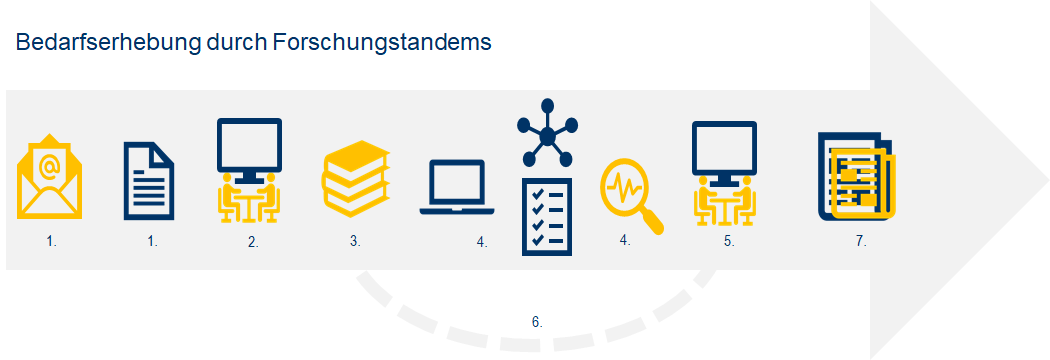
The research questions are posed to the Daidalos project by the research community or arise, for example, during consultations or during our information events such as workshops. Collaboration in these research tandems is structured as follows:
First contact: e.g. by e-mail
iIitial consultation on research question, corpus, NLP method(s): In an initial consultation, the researchers present their research interest, a possible research question and the desired text corpus. The Daidalos team advises them on how to specify the research question and explains which analysis tools (e.g. morphosyntactic taggers, working with word embeddings) and visualization options (e.g. annotated text, graph) might be suitable.
Preparation of research material: by the researchers
Prototype, first results: As soon as the analysis results are available, the Daidalos team hands them over to the researchers for evaluation.
Second discussion of results: In a further discussion, the researchers evaluate the quality of the results and the visualization together with the Daidalos team.
Iteration of steps 3-5 if necessary: If necessary, the parameters are adjusted and further analysis runs are carried out.
Cooperative publication: The knowledge gained from the research tandems is used as use cases for setting up the web-based infrastructure and designing the learning materials. The approach and the results are published jointly.
The natural language processing tools offered by Daidalos enable the analysis of linguistic phenomena (e.g. word types, collocations, syntax) as well as of literary questions (e.g. genre features, paraphrase search, ancient concepts).