… on epitaphs#
Epitaphs in Ancient Greek Literature#
Can a semantic analysis of πόλις, πρόγονοι, and ἀρετή help us better understand the representation of mourning in three selected epitaphs? This Daidalos research tandem compares the three funeral orations both with one another and with the broader corpus of Thucydides, Lysias, and Plato, using natural language processing (NLP). In doing so, the project contributes to answering philological and historical questions from a new perspective.
Research question:
What stylistic and thematic differences can be observed between the epitaphs of Thucydides, Lysias, and Plato, both among themselves and in comparison to their other works?
In a research tandem with NLP expert Konstantin Schulz from the Daidalos team, Joshua Burgert investigates this question from a classical-philological perspective. The study is supported and deepened by the NLP method of word embeddings, which identify the semantic context of selected target words (πόλις, πρόγονοι, and ἀρετή). This approach is complemented by a co-occurrence analysis, and the results are visualized in a series of visual network graphs.
Corpus information:#
Language: Ancient Greek
Period: 5th - 4th century BCE
Genres: (Attic) epitaphs; historiography; forensic speeches; philosophical dialogues
Authors: Thucydides, Lysias, Plato
Keywords: Athens; political rhetoric; funeral oration; epitaphios logos; war; grief
Corpus composition:#
1. Epitaphs (study corpus):
Thucydides, History of the Peloponnesian War 2.35-2.46
Funeral oration by Pericles for those fallen in the war year 431 BCE
Plato, Menexenus
Dialogue between Socrates and Menexenus, including a funeral oration by Socrates for the fallen of an unspecified war
Lysias, Oration 2
Funeral oration for those fallen in the Corinthian War
2. Reference corpus: all other texts by the three authors
Methodology, workflow, and challenges:#
After clarifying the research framework, the two tandem partners agree on digital methods of distributional semantics. They therefore follow the assumption that the meaning of a word arises from the context in which it is embedded.
In this first step, the classical philologist Joshua identifies three central terms:
|
πόλις state |
πρόγονοι ancestors |
ἀρετή virtue |
Two methods are used to reveal their respective semantic embedding:
Co-occurrence analysis shows which words the target terms in the original texts occur particularly frequently within a defined context. Example: ἡμέτεροι πρόγονοι
Word embeddings complement this perspective by modeling semantic proximity based on indirect textual relations in a defined context.
This methodological combination enables both precise close reading and exploratory visualizations in the form of semantic networks.
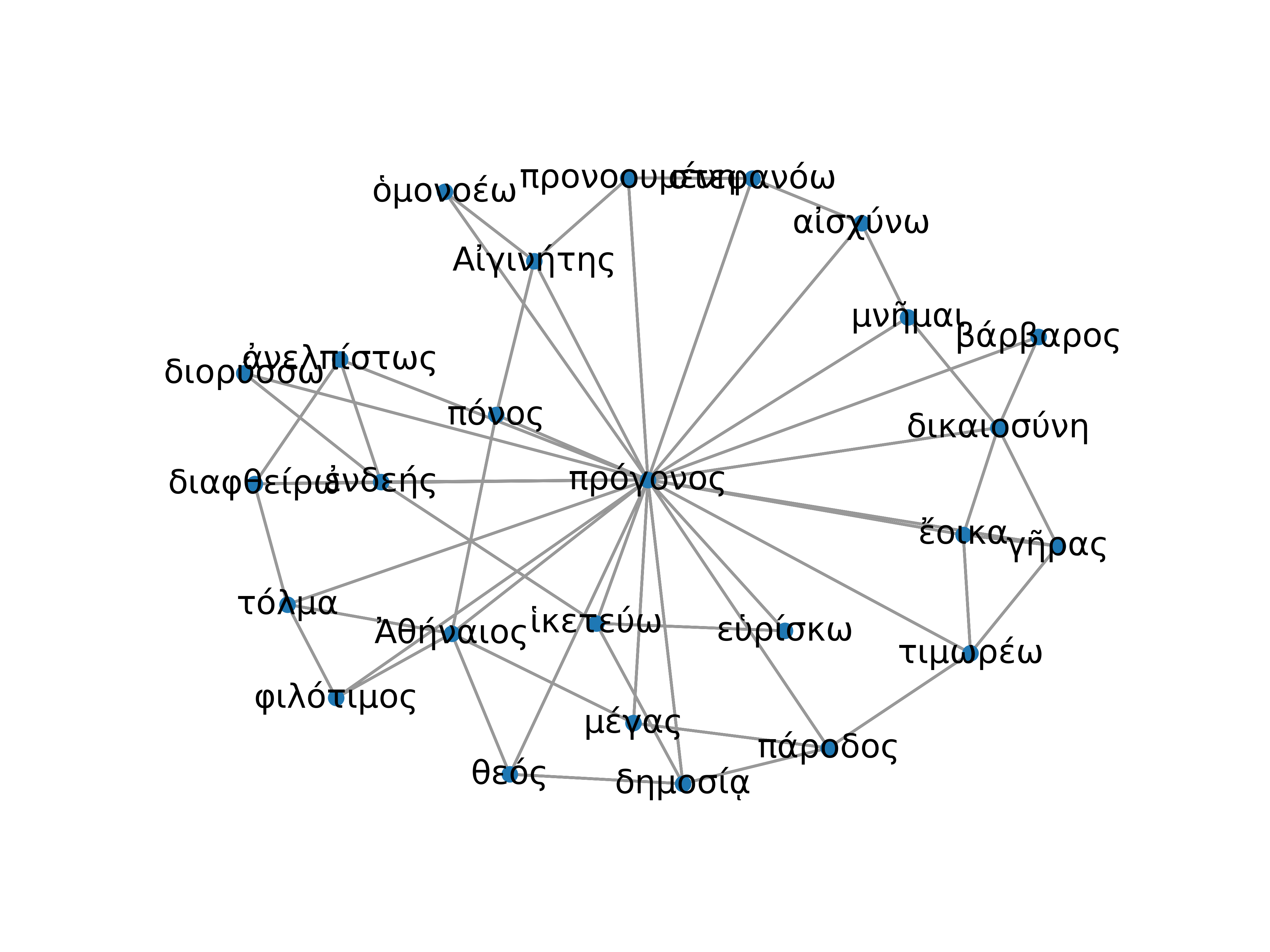
Figure: Lysias, Epitaph; yet without the connection ἡμέτεροι πρόγονοι.
The research team also encountered challenges during data preparation:
For example, it turned out that expected word combinations such as ἡμέτεροι πρόγονοι were initially missing from the automated co-occurrence network, even though they actually appear several times in the text.
Why does this happen? The issue was predictable, and the researchers already had a solution in mind. To exclude terms irrelevant to the research question, they used so-called stopword lists. These are predefined lists of words to be ignored and therefore not visualized in the analysis. Such frequent, semantically light words include pronouns, articles, prepositions, and conjunctions.
Since Daidalos relies on existing data sets, the team also made use of an already established stopword list. However, as this list contained possessive pronouns, the expression ἡμέτεροι πρόγονοι (our ancestors) was filtered out.
The researchers adapted the extensive stopword list (available here) accordingly.
With the obstacle removed, they are now ready to face the next challenges…
Note: For simplicity, we are only referring to co-occurrence networks here. In practice, the workflow was more complex: the networks were primarily based on word embeddings, which were refined by co-occurrence values.
Further reading:
You can learn more about Joshua‘s reflections on the different phases of the tandem here:
A presentation of the project‘s intermediate results after three iterations is available via Zenodo
A detailed report on the collaboration is currently in preparation and will be linked here upon publication.
For more news about the Daidalos project – and soon also about the research tandems – visit our LinkedIn channel.